WHY DO WE KILL? — Authors discuss book while being filmed by C-SPAN
Posted By AL Forman On 'Sunday, October 16th 2011 @ 11:30 PM' @ 11:30 PM In Archive | 1,415 Comments
 [1]
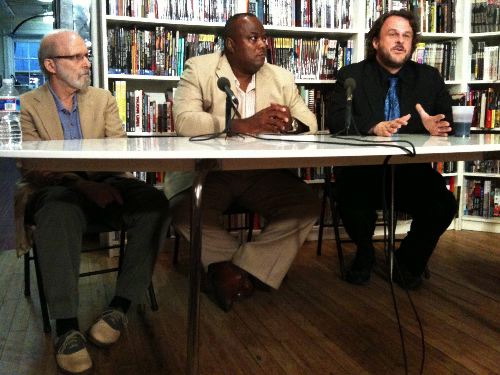
[1]WHY DO WE KILL? — Retired Homicide Detective and author Kelvin Sewell (center) is joined by co-author Stephen Janis (right) at SRO forum telecast live online by C-SPAN2's BookTV recently at Atomic Books in Hampden, as book's editor AL Forman looks on. (VoB Photo/Eric Friedman)
SEWELL AND JANIS HOLD DISCUSSION
AT PACKED BOOKSTORE IN HAMPDEN
C-SPAN reruns BookTV video Oct. 17
By Alan Z. Forman
The culture of crime in Baltimore’s inner city will not change significantly until “the borders of the city are opened up to the state,” a forum filmed and aired live online by C-SPAN was told recently by a retired chief homicide detective and an investigative reporter who addressed an overflow gathering at the independent bookstore Atomic Books in Hampden.
However Stephen Janis, co-author of the new book Why Do We Kill? a compendium of the major murder cases in the city in the last five years, in association with former Homicide Investigator Kelvin Sewell, acknowledged it’s “highly unlikely that will happen in our lifetime.
“Everyone in Maryland is responsible in some degree” for the fact that Baltimore’s murder rate is among the highest in the country, Janis said, in addressing the central question raised by his and Sewell’s book: Why Do We Kill?
He said the pronoun “we” was purposely used in the title to emphasize that we’re all responsible, at least in part.
Janis chronicles 11 major murder cases Sewell’s detective division investigated in the years prior to his retirement this past winter, which make up approximately three-fifths of the book, with the remainder a discussion of Sewell’s career experience in the Baltimore Police Department over a 22-year period.
‘THE BEST OF THE BEST’
“I’ve seen it all,” Sewell told the standing-room-only gathering, which included a number of detectives, current and retired, who worked in his squad and who told Voice of Baltimore he was “the best of the best.”
Several area news reporters and at least one local columnist were in attendance as well, one of whom — a reporter for the Baltimore Afro-American Newspaper — told the journalist and detective she agreed with their assessment that far more needs to be done to change the pattern of crime within the city’s younger population.
Shernay Williams, who wrote extensively on crime prior to leaving the Afro this past summer to pursue a career in freelance journalism and film production, said she believed — from personal experience — that it was possible for African-American youth to break free of the gang and murder culture only if they had the benefit of good parenting and/or mentoring.
STARTS AT AN EARLY AGE
Sewell and Janis agreed, emphasizing that criminal activity in the inner city starts at an early age.
Asserting that it’s critical to “set kids on the right path at the elementary school age,” Detective Sewell then cited one of the cases detailed in the book, where a 52-year-old convicted sex offender was hired as a babysitter for a nine-year-old boy by the youth’s drug-addicted mother, who Sewell said was ultimately charged with child negligence herself.
The man killed the boy two years later in a jealous rage when the boy asked him for money so he could buy a gift for a girl he liked at school.
“What makes a 52-year-old man think he’s having a love affair with a nine-year-old boy?” Sewell asked rhetorically. And what makes a mother entrust her son to a man she knows has already been found guilty of a child sex offense?
CRIMINALS’ DETACHMENT IN ‘THE BOX’
Sewell spoke of the detachment he experienced in many of the criminals he interrogated in “the box” — the room at Police Headquarters where suspects are questioned, made famous by TV cop shows like “Homicide: Life on the Street” and “The Wire” — as well as in some of the families he dealt with over the years.
In one case, he said, a 4-foot-10-inch 14-year-old confessed after intensive questioning to murder, then asked innocently, “Can I go home now?”
In another case a group of teenage girls — one of them a college student from an apparently nice family — who burned a man alive, spoke dispassionately about the crime “as if they were talking about a trip to the mall,” he said.
When Sewell telephoned the college student’s mother —a regional manager for a fast-food company — following the teenager’s confession, the mother was in total denial:
DAUGHTER IS AT HOMICIDE
“Your daughter is here with us at Homicide,” Sewell told the girl’s mother.
“That’s impossible, she’s in Atlanta” at college, the woman responded, refusing to recognize that her daughter had committed a horrific crime.
“For she wasn’t a child of the ghetto,” Sewell says in the book, “a castaway without parental guidance or educational opportunity. She didn’t fit the mold.”
Others did fit the mold, however: A young boy who shot a woman he didn’t know in the back of the head; and a 16-year-old girl who killed a teenage Wendy’s worker for her cellphone, then ate the victim’s unfinished sandwich as the young woman lay bleeding to death on the ground at the North Avenue Light Rail Station.
Describing the nature of the murders discussed in the book as “compelling” despite their gruesomeness, Sewell and the book’s editor, Voice of Baltimore’s managing editor and content director, promised the audience: “You’re not going to be able to put it down.
ORIGINALLY AIRED IN MID-AUGUST
The discussion was originally aired in mid-August by C-SPAN2 on its BookTV weekend telecast, then made available online. It is scheduled to be rerun late tonight.
Benn Ray, co-owner of Atomic Books, moderated the forum.
Published by Baltimore True Crime in association with Voice of Baltimore, Why Do We Kill? may be purchased at Atomic Books (click here) [2] or online at Amazon.com as follows:
TO ORDER THE BOOK WHY DO WE KILL? in paperback click here. [3]
OR ORDER THE EBOOK WHY DO WE KILL? (Kindle edition) by clicking here. [4]
(It is not necessary to purchase a Kindle to read the book.)
Kelvin Sewell is now chief of the Pocomoke City Police Department on Maryland’s lower Eastern Shore, where he moved his family shortly after retiring from the BPD.
Stephen Janis is investigative news producer at WBFF-TV Fox45 in Baltimore.
Alan Z. Forman is managing editor/content director of VoB and editor of the Baltimore Business Journal’s Morning Edition.
C-SPAN’s rerun of the July 29 video is scheduled to run on C-SPAN2’s BookTV tonight from 2-3 a.m.
alforman@voiceofbaltimore.org
Article printed from : http://voiceofbaltimore.org
URL to article: http://voiceofbaltimore.org/archives/674
URLs in this post:
[1] Image: http://voiceofbaltimore.org/wp-content/uploads/2011/10/FormanSewellJanis@AtomicBooksJuly2011.jpg
[2] may be purchased at Atomic Books (click here): http://www.atomicbooks.com/index.php/why-do-we-kill-pathology-murder-baltimore.html
[3] TO ORDER THE BOOK WHY DO WE KILL? in paperback click here.: http://www.amazon.com/Why-Do-Kill-Pathology-Baltimore/dp/1463534809/ref=sr_1_9?s=books&ie=UTF8&qid=1309048813&sr=1-9
[4] OR ORDER THE EBOOK WHY DO WE KILL? (Kindle edition) by clicking here.: http://www.amazon.com/Why-Kill-Pathology-Baltimore-ebook/dp/B005CXHTWC/ref=sr_1_2?s=digital-text&ie=UTF8&qid=1310869973&sr=1-2
Click here to print.