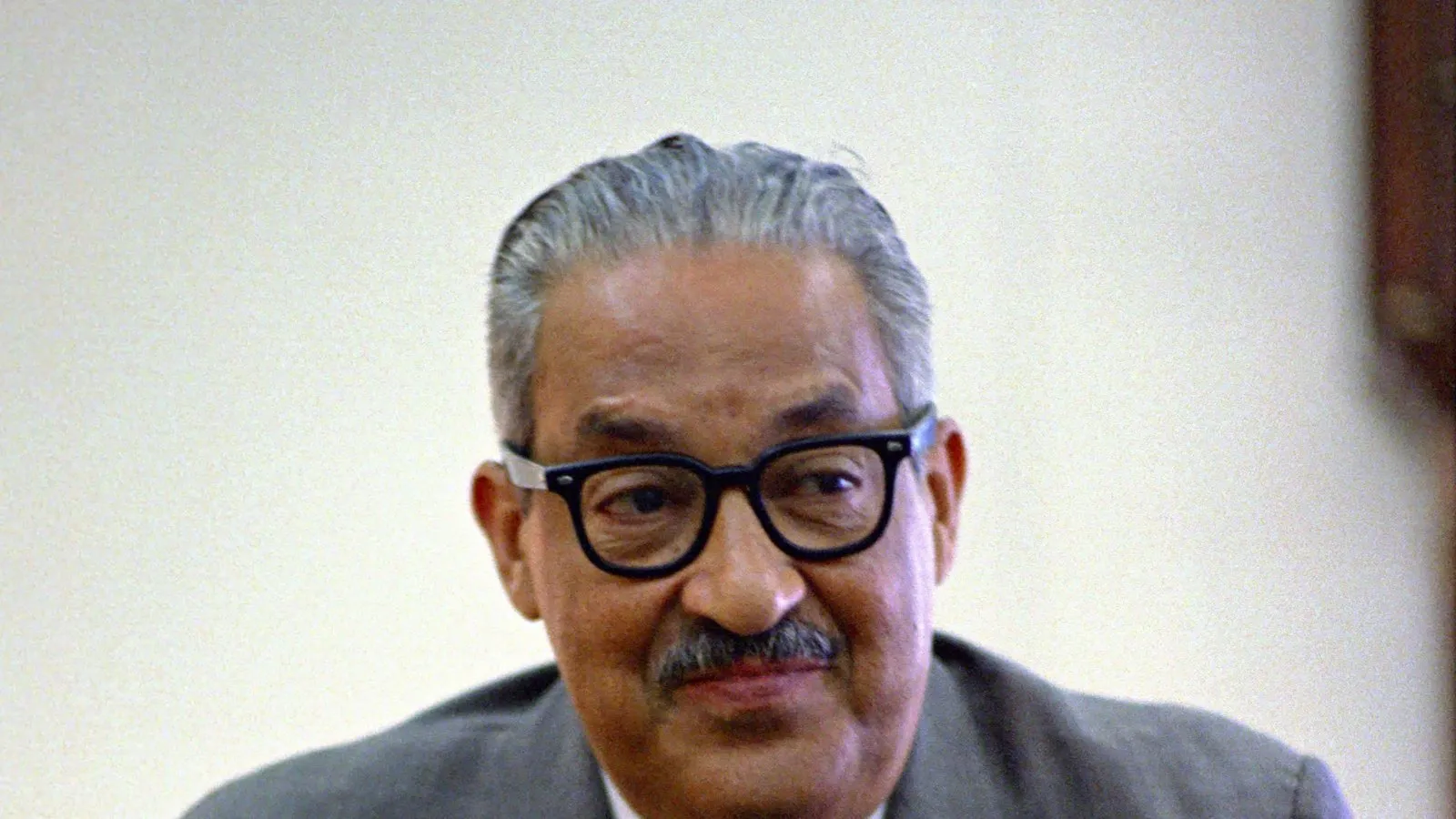
Thurgood Marshall in 1967, the year he joined the U.S. Supreme Court. Photo: Yoichi R. Okamoto / LBJ Library, public domain
Thurgood Marshall was born in Baltimore on July 2, 1908, and the city shows up at nearly every turn of his career: the law school that would not take him, the case that forced it to take someone else, and a bronze statue on Pratt Street that he came home to see dedicated.
Marshall is remembered nationally for Brown v. Board of Education and for becoming the first Black justice on the U.S. Supreme Court. In Baltimore, the story starts earlier and closer to home.
A Baltimore law practice, and a case against the state
After earning his bachelor’s degree at Lincoln University in Pennsylvania in 1930 and his law degree at Howard University in 1933, Marshall went straight back to Baltimore. According to his Federal Judicial Center biography, he was in private practice in the city from 1933 to 1937 and worked with the NAACP’s Baltimore regional office from 1934 to 1940, first as counsel and later as special counsel.
The University of Maryland School of Law had not been an option for him. When Marshall sat for a Baltimore sculptor in 1977, he told a Baltimore Sun reporter about being denied admission there, according to an account by the Jewish Museum of Maryland, which holds the sculptor’s papers and models.
Within two years of finishing at Howard, he was helping to take the school to court. Donald Gaines Murray applied to the law school on Jan. 24, 1935, and was rejected because of his race, according to the law school’s own library, which now carries Marshall’s name. Murray’s appeal to the university’s Board of Regents also failed. By the time the case reached court, he was represented by Charles Hamilton Houston and Marshall, with help from Baltimore attorney Nicholas Gosnell.
Marshall’s argument was that Maryland had no comparable law school for Black students, so Murray had to be admitted to the one it had. The library quotes him: “What’s at stake here is more than the rights of my client. It’s the moral commitment stated in our country’s creed.”
Judge Eugene O’Dunne, hearing Murray’s petition in Baltimore, ordered university president Raymond A. Pearson to admit Murray. The Maryland Court of Appeals affirmed the ruling on Jan. 15, 1936. Murray graduated in 1938 and practiced law in Baltimore. The library notes the case helped Marshall develop the arguments he would later make in Brown.
From the NAACP to the court
Marshall led the NAACP Legal Defense and Educational Fund from 1940 to 1961. He then served on the U.S. Court of Appeals for the Second Circuit, from a 1961 recess appointment by President John F. Kennedy until 1965, and as U.S. solicitor general from 1965 to 1967. President Lyndon B. Johnson nominated him to the Supreme Court on June 13, 1967. The Senate confirmed him on Aug. 30, and he took the oath on Oct. 2, 1967. He took senior status in 1991 and died on Jan. 24, 1993.
The statue behind the courthouse
In 1977, the city commissioned a statue of Marshall for the Edward A. Garmatz Federal Courthouse, and Baltimore sculptor Reuben Kramer won a nationwide competition for the job. Over three years Marshall came to Kramer’s studio for several sittings, the museum’s account says. The 8 1/2-foot bronze was installed in April 1980 on Pratt Street and dedicated on May 16, 1980, with five other Supreme Court justices in attendance and music from the band and choir of Douglass High School.
Marshall did not treat it as a victory lap. “When you see this statue, I hope you won’t think this is the end of it,” he told the crowd, according to the museum. “We’ve got a lot more to do.”
The placement has drawn complaints since the beginning: the statue stands behind the courthouse on Pratt Street, not at its front door, a few blocks from the Harborplace site now headed for a Dec. 2 vote. Kramer’s original plaster model went to Douglass High School.
The state has added its own honors since. A statue of Marshall by Toby Mendez went up at State House Square in Annapolis in 1996, and under a 2005 state law, the region’s main airport became Baltimore/Washington International Thurgood Marshall Airport that Oct. 1.
More profiles of Marylanders who shaped the city, including Barbara Mikulski’s East Baltimore story, are in our People & Profiles section.
Helen Ashbury covers Baltimore for Voice of Baltimore.