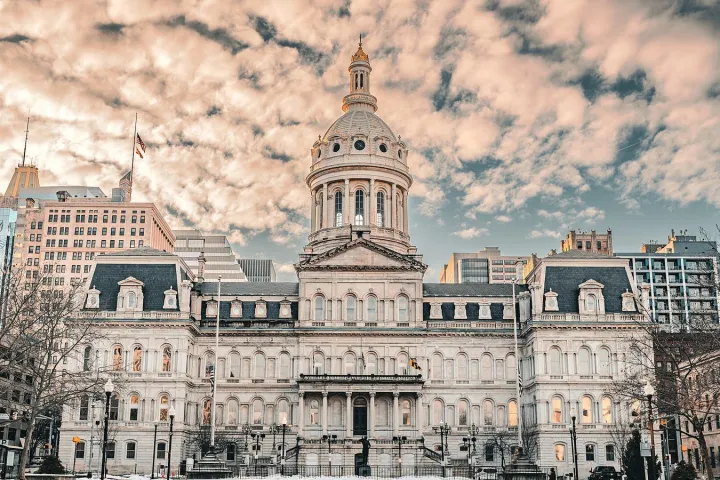

Prettyboy Dam, part of the city-owned reservoir system in Baltimore County. Photo: Pviper101112 / Wikimedia Commons, CC BY-SA 4.0
Baltimore and Baltimore County have signed an agreement to study merging their tangled water and sewer operations into one utility, with a final answer on whether it can work due by Oct. 1, 2028.
Mayor Brandon M. Scott and County Executive Katherine A. Klausmeier signed the memorandum of understanding Nov. 17, according to the mayor’s office. Under the plan they are studying, the city and county would keep owning their pipes, plants and pump stations, but a single utility would run and maintain them, with a governing body that represents both.
For city households, the agreement is the next step after this month’s charter vote. Voters approved a standalone Department of Water and Wastewater, separate from the Department of Public Works, and the text of the MOU says that department takes effect Jan. 1, 2029. The city’s release says the separation is meant to happen alongside the creation of the regional utility.
Why the two systems are so hard to pull apart
The MOU’s background section reads like a short history of how the arrangement got this complicated. The city bought the private Baltimore Water Company in 1854 for $1.35 million. State laws in 1915 and 1949 let it dam the Gunpowder and Patapsco rivers, flooding land outside the city to create Loch Raven, Prettyboy and Liberty reservoirs.
Today the city owns and operates all three reservoirs, the filtration plants, the pumping and storage system and the wastewater treatment plants that serve the region. Many of those assets sit in Baltimore County. The county owns its own sewer network, which the MOU puts at 120 pump stations and 3,178 miles of line, and it pays for capital work on the water mains inside its borders. But the city maintains those county water mains.
Costs are split under agreements from 1972 and 1974 that have no expiration date. They use a cost allocation model and an annual “true-up,” and the MOU says the cost sharing has “led to ongoing disputes and challenges that delay full financial reconciliation.” Disputes go to binding arbitration. The last round, in the 1980s, took more than a decade to settle, the document says.
“So many of the challenges we’re discussing, from maintenance responsibilities to billing and metering, will be fixed through a single, centralized utility,” Scott said in the release. Klausmeier said residents do not care which jurisdiction is responsible when a main breaks. “They expect government to work together to fix the problem,” she said.
What the study will look at
The agreement commits both governments to share staff and consulting costs, subject to their budget processes, and to study:
- a single operator for billing and metering, maintenance, capital planning and construction, customer service and regulatory compliance;
- how to structure a governing board with fair representation for both jurisdictions;
- combined customer assistance and billing-dispute programs;
- a cost-of-service study for the whole region, including wholesale customers in Howard, Anne Arundel and Harford counties and BWI Thurgood Marshall Airport; and
- ways to limit the financial risk each jurisdiction carries.
The city and county must send status reports twice a year to the mayor, the county executive, the governor and the General Assembly. The final report has to say whether a unified system is feasible and why. If either side decides it is not, the report must recommend that they ask the state for guidance. The MOU expires Jan. 1, 2029, unless both sides extend it.
Comptroller Bill Henry, who chaired the Baltimore Regional Water Governance Model Work Group, said in the release that the change would mean city residents “pay a more equitable share of the full financial burden of these systems” while county residents get “a more equitable voice in the operation of these systems.” The work group grew out of a 2021 joint review of the shared system and a task force that made its recommendation in 2024.
What it means for your bill now
Nothing changes on water bills because of the MOU itself. It is an agreement to study and plan, not a merger. Baltimore County Executive-elect Julian Jones said in the release he looks forward to “building on their work.”
City customers who are behind can still apply for help through Water4All, and DPW recently expanded its no-cost sewage cleanup program to some dry-weather backups. More from City Hall is in our City Hall section.
Calvin Riggs covers Baltimore for Voice of Baltimore.