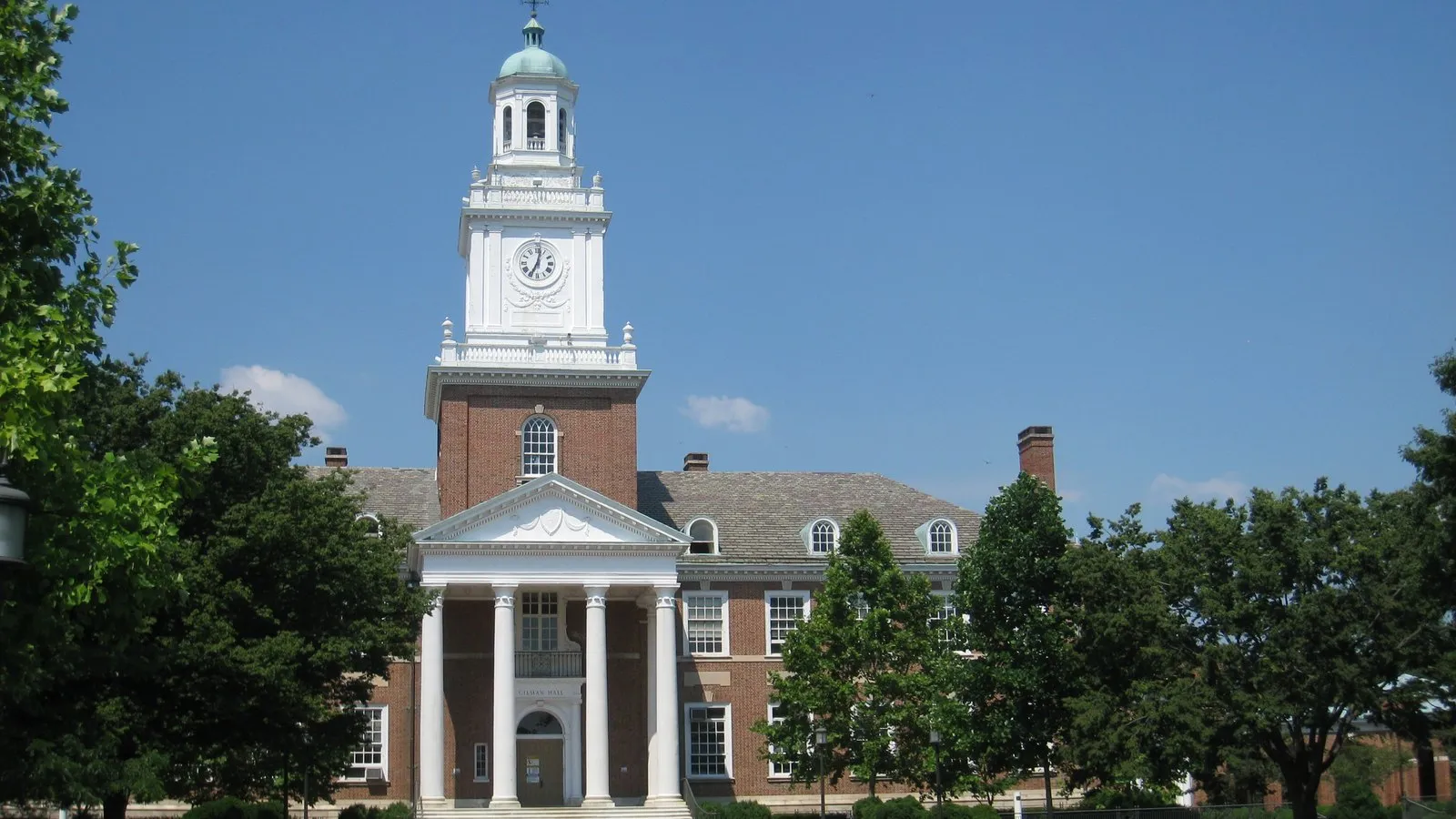
Gilman Hall on Johns Hopkins' Homewood campus. Photo: Daderot / Wikimedia Commons, public domain
Lainie Rutkow, who has run Johns Hopkins University’s academic side on an interim basis since February, becomes its permanent provost on Tuesday, Dec. 1. President Ron Daniels announced the appointment Nov. 24, making Rutkow the university’s 17th provost.
The provost is the university’s chief academic officer, and the job carries real weight in Baltimore. The decisions that run through that office, on faculty hiring, research money, admissions and student life, shape one of the city’s largest employers and the Homewood, East Baltimore and Peabody campuses that anchor several neighborhoods.
Rutkow was picked after a global search led by a committee chaired by Theodore DeWeese, dean of the School of Medicine and CEO of Johns Hopkins Medicine, according to the university’s announcement. “It is gratifying to find the ideal candidate in our midst,” Daniels wrote in his message to the university community.
A Hopkins insider
Rutkow is a public health lawyer and policy scholar who has spent more than two decades at Hopkins. She earned a master’s in public health and a doctorate at the Bloomberg School of Public Health, joined its faculty in 2010 and is a professor in the Department of Health Policy and Management, with joint appointments at the School of Advanced International Studies and the School of Medicine. She also holds a bachelor’s degree from Yale and a law degree from New York University.
She moved into university leadership in 2019 as senior adviser for strategic initiatives, then served as vice provost for interdisciplinary initiatives and executive vice provost. In the executive vice provost job, the university says, her portfolio covered faculty and student affairs, admissions and financial aid, institutional equity, and student health and well-being.
She stepped in as interim provost after Ray Jayawardhana left to become president of the California Institute of Technology, as the university announced in January.
Research money and the undergraduate question
The biggest item on her interim record is money for research. Rutkow helped set up the Research Resilience Fund and the Life Sciences Research Initiative, which together will provide nearly $300 million over two years to support faculty research as federal funding has shifted, according to the university. Much of that research is done in Baltimore labs, on the Homewood and East Baltimore campuses.
She also co-chairs the university’s AI Steering Committee, which is writing guidance on artificial intelligence in teaching, research and administration, and oversaw the launch of the School of Government and Policy, the university’s newest academic division. Earlier, she helped run the Johns Hopkins Coronavirus Resource Center during the pandemic.
The undergraduate side will also land on her desk. Earlier this month, Hopkins formed a committee to weigh enrolling more undergraduates, a question with obvious stakes for the neighborhoods around Homewood. The university credits Rutkow with work on the undergraduate experience, support for graduate students amid federal funding changes, and making a Hopkins education more affordable.
“This moment calls on universities to reaffirm the value we bring with clarity and conviction, as we offer our best ideas to the people we serve,” Rutkow said in the announcement.
Her term begins Dec. 1. For more on the institutions that shape city life, see our news coverage and our recent profile of Peabody cellist Amit Peled, whose conservatory is part of the same university.