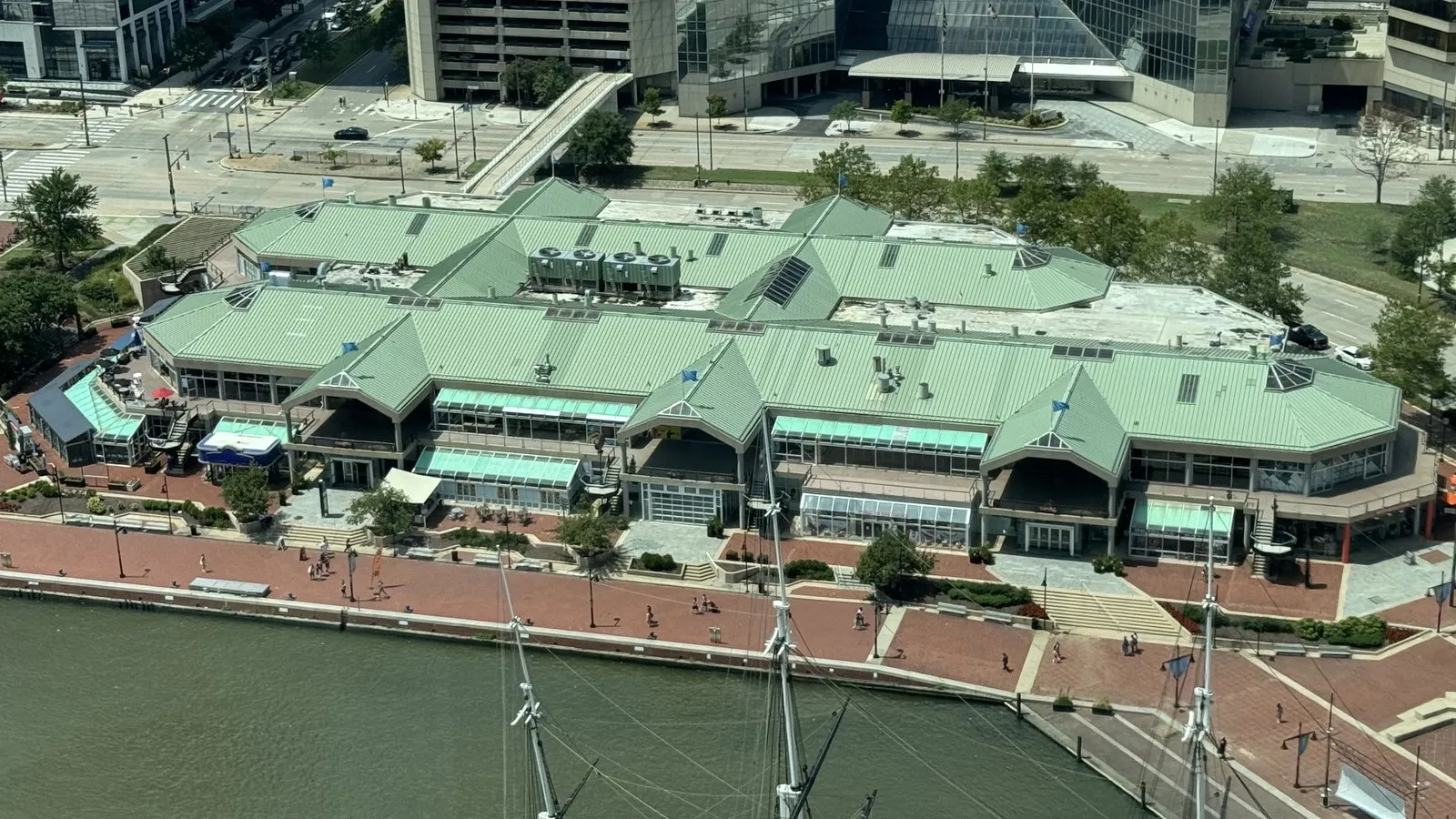
The Harborplace pavilions on the Inner Harbor. Photo: Toohool / Wikimedia Commons, CC BY-SA 4.0
Baltimore’s Board of Estimates will vote Dec. 2 on the deal that would let MCB Real Estate tear down and rebuild Harborplace. City Hall released the four agreements behind it on Thursday, and they show what the city gets, what it gives up and what has to happen before any construction starts.
Mayor Brandon Scott and the Baltimore Development Corporation announced the terms Nov. 19. The package is a ground lease, a payment in lieu of taxes (PILOT) agreement, a community benefits agreement and a profit-sharing agreement. The Board of Estimates meets at 9 a.m. Wednesday, Dec. 2; meetings are open to the public and streamed on CharmTV.
“Over my lifetime, I’ve seen countless deals that advantaged private developers at Baltimore’s expense, and I was committed to doing things differently in this negotiation,” Scott said in the release.
The tax math
The biggest piece is the PILOT agreement. Instead of regular property taxes, MCB would make set payments for 25 years. The city says it is guaranteed at least $543,000 a year, or $35.36 million over the life of the deal.
The administration’s comparison is to doing nothing. According to the release, the two pavilions are losing about $10 million in assessed value a year, and without redevelopment they could bring in as little as $23,000 a year in property taxes, about $4.03 million through 2054. By that measure, the city says, the deal yields more than three times as much.
Critics measure it against what a finished project would owe at full rates. Baltimore Brew calculated the break at about $366 million, or 95% of the property taxes, over 25 years.
Under the profit-sharing agreement, the city gets a 20% share of profits only if the project beats MCB’s profit expectations by 20%.
What residents are promised
The community benefits agreement and the city’s summary list these commitments:
- A $10 million community fund for downtown, overseen by an advisory board, for programs such as summer youth work, Youthworks, free outdoor events and graffiti removal.
- A $5 million equity fund that would let Baltimore residents invest in the project and share in profits.
- Ten percent of apartments set aside as affordable, priced for households at 50% and 60% of area median income.
- Thirty-five percent of construction hours for city residents, 40% of construction contracts for minority- and women-owned firms, and 55% of new permanent hires from the city.
- Union representation for public maintenance workers, including AFSCME members. The city said MCB is negotiating with UNITE HERE and the building trades.
- 4.5 more acres of parks and public space, for 18.7 acres in all, plus replacement and raising of the Inner Harbor seawall.
The city projects about $2 billion in economic activity during construction, including $26.4 million in direct revenue to the city and more than 8,500 construction jobs.
The financing safeguard
One clause speaks to a fear that has followed the project for months: that the pavilions could come down and the money could run out. Under the deal, “MCB cannot begin construction without demonstrating to the City’s satisfaction that they have secured financing to complete each phase of the project,” the release says. MCB and BDC would also publish annual audited financial statements.
Residents suing the city over the project have asked a judge to block demolition of the pavilions, Baltimore Brew has reported. That case is separate from the Board of Estimates vote.
The Light Street piece
The redevelopment also depends on taking over the five-lane Light Street spur next to the pavilions. On Thursday the Planning Commission voted 6-0 to approve a City Council bill authorizing the city to close parts of Calvert, Light and Pratt streets, Baltimore Fishbowl reported. The bill goes next to the council’s Land Use and Transportation Committee, which has not set a hearing.
The board taking the vote is also in line for changes after voters backed Question F this month, as we reported in our election coverage. The deal also lands as agencies are being told to plan for 5% budget cuts, which is why the guaranteed payment floor is getting close attention.
All four agreements are posted at baltimorecity.gov/harborplace. Follow the vote and the council hearing in our City Hall coverage.
Calvin Riggs covers Baltimore for Voice of Baltimore.