Stephanie C. Rawlings-Blake, flanked during 2010 parade by City Council Members Rochelle ‘Rikki’ Spector (D-5th), left, and William H. Cole 4th (D-11th), was inaugurated Tues. for a full 4-year term as Balto.’s mayor. (VoB File Photo/Stephen Janis)

FORMER  EHRLICH  CAMPAIGN  MANAGER
ALSO CONVICTED IN ROBOCALL SCHEME

A good/bad day for Maryland politicians

THE SPECTRE OF SHEILA DIXON

By Alan Z. Forman

At almost the identical hour the Mayor of Baltimore was sworn in for her first full term Tuesday by a court clerk accused of “brandishing” a handgun and trying to punch a local blogger who had prevented the reelection of the clerk’s daughter to the City Council, the campaign manager of former Gov. Robert Ehrlich was convicted of election fraud, and ex-P.G. County Executive Jack Johnson was sentenced to seven years in prison for bribery and corruption.

Barely two blocks from City Hall, outside of which Stephanie Rawlings-Blake took the oath of office administered by Clerk of the Courts Frank M. Conaway Sr., Ehrlich Campaign Manager Paul Schurick was found guilty on all counts relating to illegal robocalls made on Election Day 2010 in a botched attempt to prevent voters from casting ballots for Gov. Martin O’Malley, who went on to defeat Ehrlich by a wide margin.

The calls were allegedly orchestrated by political operative Julius Henson, who the Ehrlich campaign paid just over $1 per voter contacted — for a total of $112,000 — in a Republican attempt to suppress African-American votes for Democrat O’Malley.

Henson, who is scheduled for trial on similar charges in February, has said the calls were not meant to keep black voters from going to the polls and that he does not believe the phone messages were illegal.

Schurick was tried in the Clarence M. Mitchell Jr. Courthouse, the back of which faces City Hall. Blake’s oath of office was administered, as is customary, by the city’s Circuit Court clerk.

Read more »


Near-extinct buffalo nickel is subject of a flawed David Mamet play at CenterStage scheduled to run through Sunday Dec. 11.

CENTERSTAGE  PRODUCTION
FAILS TO EARN 5-STAR NOD
FROM VOICE OF BALTIMORE

Removing the F and the U

By Harvey House

There are 26 letters in the English alphabet. Remove the F and the U and David Mamet would be completely lost.

Which is certainly the impression this critic had five minutes into “American Buffalo,” the current cask of holiday cheer being served up at CenterStage. It is not a play for the erudite or easily offended.

Thirty-six years ago, when “American Buffalo” premiered at the Goodman Theatre in Chicago and then went on to win Obie Awards in New York (along with Mamet’s “Sexual Perversity in Chicago”) for “Best New American Plays,” the playwright was hailed as a groundbreaking realist, pushing the boundaries of a society at war with itself.

But that was 1975. A lot has changed since then.

Liesl Tommy, who directed the CenterStage production, said she was drawn to this play in part because “the content is terribly relevant to what’s happening in America today.”

Really?? Try telling that to the director of a 2008 revival of “American Buffalo” that closed after only eight performances at New York’s Belasco Theatre on Broadway, despite the star power of John Leguizamo, Cedric the Entertainer and “Sixth Sense” Oscar nominee Haley Joel Osment.

Read more »


Clerk of Courts Frank M. Conaway Sr., left, allegedly threw a punch and brandished handgun at blogger Adam Meister.

CONAWAY ALLEGEDLY
‘BRANDISHED’  GUN
AT ADAM MEISTER

Local activists came to the defense today of Circuit Court Clerk Frank M. Conaway Sr. at a sparsely attended rally outside the Clarence M. Mitchell Jr. Courthouse in downtown Baltimore.

Led by the NAACP’s Rev. Cortly C. D. Witherspoon and former Baltimore City Branch President Marvin L. “Doc” Cheatham, the group demanded a “full, thorough and transparent investigation” into an altercation that occurred Nov. 21 between Conaway and blogger Adam Meister outside the court clerk’s home in Northwest Baltimore, during which police officers on the scene reported that Conaway “brandished” a gun.

Immediately following the altercation the Office of the City State’s Attorney referred the matter to an outside prosecutor to conduct the investigation, in order “to avoid any conflict of interest or appearance thereof,” noting “Mr. Conaway’s position with the Court in which our Office conducts its business.”

However at Monday’s rally, Cheatham declared, “We find Adam Meister’s conduct suspect” and are “not going to sit here quietly and allow someone to try to intimidate any elected official.”

Meister has said he did not personally see a gun but that Conaway threw a punch at him which missed. Conway retorted by stating that if he had in fact tried to punch Meister — which he insists he did not do — he “would not have missed.”

Read more »


“Cat on a Hot Tin Roof,” advertised as “a color-blind production of the Pulitzer Prize winning tale” written in 1955 by playwright Tennessee Williams, is playing at the Load of Fun Theater on West North Avenue.

PRODUCTION OF CLASSIC 1955 PLAY
IN CITY’S STATION NORTH DISTRICT
IS METAPHOR FOR SOCIAL CHANGE

By Alan Z. Forman

Baltimore was a divided segregated city when Tennessee Williams’ “Cat on a Hot Tin Roof” debuted on Broadway and won the Pulitzer Prize for Drama in 1955.

Blacks could not eat at public lunch counters in Charm City (and elsewhere in America) and didn’t venture into upscale Guilford or even lowly Hampden. Residents of Polish descent confined themselves to Highlandtown and Canton; Jews were not allowed in Roland Park. Italians lived in Little Italy.

People of color didn’t mix with whites except to work for them.

Downtown Baltimore was lily white. Department stores had “colored” restrooms; Read’s (the predecessor of Rite-Aid) had segregated lunch counters. City Hall was a Caucasian enclave.

Public schools, suddenly desegregated by federal statute after 1954, were still divided racially, ethnically and by religion. It was highly unusual to see mixed-race couples anywhere in town.

Minorities kept to themselves, remaining in their own neighborhoods, shopping areas and hangouts. Races and ethnicities didn’t mix; blacks did not hang out with whites. Not in restaurants, not in movie theaters, not in stores.

And not in government.

It was even more pronounced in other parts of the South, the deep South.

Read more »


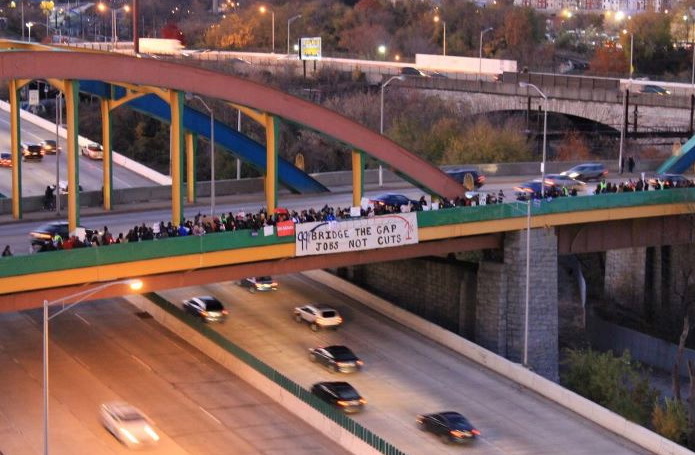
Protesters 'occupy' Howard Street Bridge just south of North Avenue Thursday in march against unemployment. Trucks may be seen crossing North Ave. Bridge in background, while Jones Falls Expwy. traffic moves under bridge, foreground. (VoB Photo/Courtesy, Good Jobs Better Balto.)

NATIONWIDE  PUSH
NETS LARGE CROWD
ON  BUSY  BRIDGE

By Anthony C. Hayes

A peaceful but passionate crowd numbering about 150 gathered Thursday at the busy intersection of Howard Street and West North Avenue, joining others across the nation in a national day of protest.

Their march across the Howard Street Bridge was touted as a call to “bridge the gap” against corporate greed and unemployment. Similar events were held in at least 30 other U.S. cities.

Protesters hoped to call attention to the plight of the unemployed while decrying congressional moves which have effectively blocked the President’s jobs plan. Other issues of concern expressed by the protesters included proposed cuts to Medicare, Medicaid and Social Security.

Lisa Lucas-Alston, one of the event’s organizers, told Voice of Baltimore, “We want to let people know how decaying bridges and roads are symbolic of our failing system.”

In addition, Congress needs to “stop killing jobs bills,” she declared.

John Fleissner, a senior at nearby Maryland Institute College of Art (MICA), said he became aware of the protest from a flyer he saw on campus, but that most of his classmates seemed “apathetic” to the event.

Read more »

Search VoB Archives:


Web Design Bournemouth Created by High Impact
Voice of Baltimore webpage designed by Victoria Dryden
Copyright © Sept. 2011 | All rights reserved